The Non-fiction Feature
Also in Bulletin #55:
The Children’s Spot: Our World of Dumplings by Francie Dekker and Sarah Jung
The Product Spot: Healthy soil for your garden – University of Minnesota
The Pithy Take & Who Benefits
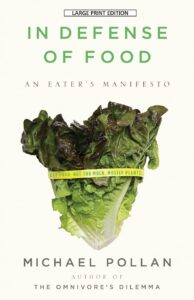
Journalist Michael Pollan, of The Omnivore’s Dilemma fame, shares his wisdom about what to eat. Although his advice can be simply boiled down to three phrases–eat food, not too much, mostly plants–he does more than merely advise; he explains. What even is our industrialized diet these days, how did it come to be, why is it changing so much, and why is it so bad for us?
I think this book is for people who seek to understand:
(1) how the Western diet (and the specter of “nutritionism”) became the processed food giant it is today, aided and abetted by corporations, the medical community, and the government;
2) how this diet wreaks havoc on our bodies; and
3) what we can do about it.
The Outline
The preliminaries
- In the last few decades, much of the traditional supermarket has been replaced by “nutrients.”
- There’s an impression that nutrients are more important than tangible food itself.
- Nutrients, as a concept, have been around since the early 19th century.
- In the beginning, vitamins gave nutrients a lot of prestige–special molecules, isolated from foods and then synthesized in a lab, could quickly cure people of nutritional deficiencies.
- Looking at the history of nutrients as a concept, no single event marked the tectonic shift from eating food to eating nutrients, but some moments come close.
- In 1977, the Senate Select Committee on Nutrition and Human Needs published health guidelines, calling on Americans to cut down on the amount of meat and dairy they ate, due to health concerns.
- There was an immediate firestorm of criticism, mostly from the meat and dairy industries, and the committee retracted those guidelines.
- This made it clear that you could not tell the people to eat less of a particular food, or the food industry would have you for lunch.
- In 1982, the National Academy of Sciences set out new dietary language, and soon words like “polyunsaturated” crept into the cultural food space, ousting the tangible material of food, and harkening the Age of Nutritionism.
- In 1977, the Senate Select Committee on Nutrition and Human Needs published health guidelines, calling on Americans to cut down on the amount of meat and dairy they ate, due to health concerns.
Nutritionism
- Nutritionism is not the same thing as nutrition–it’s an ideology.
- Ideologies are ways of organizing large swaths of experience under a set of shared but unexamined assumptions.
- This makes it hard for us to actually see ideologies, especially when they’re exerting a hold over you.
- Ideologies are ways of organizing large swaths of experience under a set of shared but unexamined assumptions.
- For nutritionism, the unexamined assumption is that the key to understanding food is the nutrient, and foods are the sum of their nutrient parts.
- Nutrients, unlike food, are invisible to the naked eye, and so we depend on scientists to explain the hidden power of food to us.
- Then, nutritionism becomes the ultimate justification for processing food, because the assumption is, with enough food science, fake foods can become more nutritious than the real thing.
- And by now, we’ve gotten so used to fake foods that we’ve forgotten what a difficult trail the original fake food–margarine–had to blaze before it and other synthetic food products could gain government and consumer acceptance.
- In 1973, after significant lobbying, the FDA repealed an old rule that prohibited imitation foods, and the new rule held that as long as an imitation product was not “nutritionally inferior” to the natural food it was copying, the imitation could be marketed.
- This threw open the door to all kinds of imitations: fats in things like sour cream and yogurt could be replaced with hydrogenated oils, for instance.
- Nutritionism became the official ideology of the Food and Drug Administration; the government had essentially redefined foods as nothing more than the sum of their recognized nutrients.
Bad Science
- It’s difficult to conclude that scientific eating has contributed to our health, especially when you consider that nutritionism favors more novel kinds of highly processed foods, and enlists the medical establishment and government to promote those products.
- Nutrition science isn’t easy
- Most of this science involves studying one nutrient at a time, even though this takes the nutrient out of the context of the food, and the food out of the context of the diet, and the diet out of the context of the lifestyle.
- Even the simplest food is a hopelessly complicated thing to analyze–it’s a virtual wilderness of chemical compounds, existing in intricate and dynamic relation to one another.
- People don’t eat nutrients, they eat foods, and foods can behave differently from the individual nutrients they contain.
- Ultimately, thirty years of nutritional advice has left us sicker and more poorly nourished. It’s clear that we need a whole new way to think about eating.
The Western Diet
- People on a “Western” diet suffer substantially higher rates of cancer, cardiovascular diseases, diabetes, and obesity than those eating most other traditional diets.
- The Western diet is laden with processed foods and meat, added fat and sugar; it lacks fruits, vegetables, and whole grains.
- Some scientists noted that Western diseases closely followed the heels of the arrival of Western foods.
- A lot of us think of chronic diseases kind of like how we think about the weather–one of life’s givens–and we’re just grateful that modern medicine is there to help when we need it.
- That is, we think of diseases in medical terms, rather than historical or evolutionary terms.
- But history and evolution and context are important.
- For instance, take processed foods. Processing foods robs them of nutrients, because that makes them easier to store and be transported over long distances–removing nutrients makes the food less vulnerable to pests.
- In contrast, one of the best ways to be healthy is to eat a traditional diet of fresh foods from animals and plants that were grown on soils that were themselves rich in nutrients.
- The industrialization of agriculture, especially the introduction of synthetic nitrogen fertilizer (which simplified the soil), has taken a toll on our health.
- By breaking links in local soils, local foods, and local people, the industrial food system has disrupted the natural flow of nutrients through the food chain.
- Our bodies, not having had time to adapt to this new system, have failed in new ways.
The Industrialization of Eating
- In nature, evolutionary adaptation is gradual: for instance, a plant becomes tastier over time, in order to gratify an animal’s needs, while the animal’s digestive tools become better over time, in order to optimally use the plant.
- In contrast, the Western diet has been an abrupt set of changes over a handful of decades.
- The Western diet has transformed our food relationships in five critical ways:
- From whole foods to refined foods
- The human brain craves basic carbs–carbs that are reduced to their energy essence, which is glucose.
- The first big change was when the industry figured out how to change seeds and grasses into what is basically sugar; this was the first time a shift like this made so many people sick–switching out a complex relationship for an overly simplified one, which our bodies were not prepared for.
- From complexity to simplicity
- The industrialization of the food chain has involved a lot of chemical and biological simplification.
- First, industrial fertilizers grossly simplify soil’s biochemistry
- Then, processing whole foods–refining, chemically preserving, etc.–deprives them of many nutrients.
- From quality to quantity
- While industrial agriculture has made tremendous strides in getting calories in the land, those gains in quantity have come at a cost to quality.
- And the more low-quality food you eat, the more you want to eat, in a futile–but highly profitable–quest for the absent nutrient.
- From leaves to seeds
- We’re eating a lot more seeds and a lot fewer leaves (and so have the animals we depend on), which is a huge dietary shift, the full implications of which we are just now beginning to recognize.
- Leaves provide a host of critical nutrients a body can’t get from a diet of refined seeds.
- From food culture to food science
- The industrialization of our food is systematically and deliberately undermining traditional food cultures everywhere.
- From whole foods to refined foods
Escape from the Western Diet
- What can we do to change things? The challenge, it seems, is to escape the worst parts of the Western diet without having to give up our general lifestyles.
- The author has some general suggestions, and then some more specific ones. For general suggestions:
- Don’t eat anything your great-grandmother wouldn’t recognize as food.
- Avoid food products containing ingredients that are 1) unfamiliar, 2) unpronounceable, 3) more than five in number, or 4) include high-fructose corn syrup.
- Avoid food products that make health claims (health claims have become hopelessly corrupt).
- Shop the edges of the supermarket and stay out of the middle.
- Get out of the supermarket whenever possible and go to the farmer’s market, where you automatically get food that is in season, which is usually when it is most nutritious.
- For plant specific suggestions:
- Eat mostly plants, especially leaves.
- Remember that eating meat in huge quantities probably isn’t a good idea, especially when the meat is from a highly industrialized food chain.
- If you do eat meat, remember that the diet of the animal you eat has a bearing on the nutritional quality.
- Add new species of plants when you can, including wild greens.
- Eat well-grown food from healthy soils (this doesn’t necessarily mean organic).
- Take a multivitamin and mineral pill after the age of 50.
- Eat mostly plants, especially leaves.
- Eat more like the French, Italians, Japanese, Indians, or Greeks, since those who eat according to the rules of a traditional food culture are generally much healthier than people eating a contemporary Western diet.
- How are these traditional methods of “food processing” different from modern food science?
- Traditional methods have withstood the test of time, keeping people well-nourished and healthy generation after generation.
- How are these traditional methods of “food processing” different from modern food science?
- Regard nontraditional foods with skepticism.
- For quantity-specific suggestions
- How a culture eats may be just as important as what a culture eats.
- Look at the French–they eat gobs of saturated fat with wine, but they seldom snack, they eat most of their food at meals shared with others, and eat small portions and don’t come back for seconds. Overall, they consume fewer calories, and manage to enjoy them more.
- Pay more, eat less
- Vast amounts of poor-quality food sold at a terrific price is something we do well. Better food usually costs more.
- Additionally, calorie restriction has repeatedly been shown to slow aging and prolong lifespan in animals, and some researchers believe it is the single strongest link between a change in the diet and the prevention of cancer.
- Overeating promotes cell division, and most dramatically so in cancer cells; cutting back on calories slows cell division. It also stifles the production of free radicals, curbs inflammation, and reduces the risk of most of the Western diseases.
- How a culture eats may be just as important as what a culture eats.
- For meal-suggestions:
- Eat meals! We’re snacking more and eating fewer meals together.
- Shared meals are uniquely human institutions where our species developed language and culture.
- You can do the following to counter the rise of the snack and restore the meal:
- Do all your eating at a table (a desk does not count)
- Try not to eat alone
- Consult your gut
- The culture of food has become a culture of the eye. But when it comes to eating, it pays to cultivate your other senses, which often provide more useful and accurate information.
- Eat slowly
- Cook and, if you can, plant a garden
In the eye of the cook or the gardener, food reveals itself for what it is: a web of relationships, each of them dependent on the other, and all of them ultimately rooted in soil and nourished by sunlight. Think of the relationship between the plants and the soil, between the grower and the plants and animals, between the cook and the growers who supply the ingredients, and between the cook and the people who will enjoy the meal. It is a large community to nourish and be nourished by.
And More, Including:
- Food and culture, and how making food choices more scientific empties them of their ethnic content and history
- The three main methods that nutrition researchers have for studying the impact of diet on health–the case-control study, the cohort study, and the intervention trial–and how all three are seriously flawed in different ways
- The critical importance of healthy soil
- How scientists are beating a quiet retreat from the idea that dietary fat is responsible for chronic disease
In Defense of Food
Author: Michael Pollan
Publisher: Penguin Books
256 pages | 2009
Purchase
[If you purchase anything from Bookshop via this link, I get a small percentage at no cost to you.]