The Non-fiction Feature
Also in Bulletin #53:
The Memoir Spot: Cost of Living by Emily Maloney
The Product Spot: KFF – Medicaid 101
The Pithy Take & Who Benefits
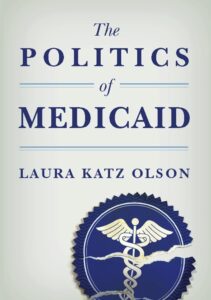
Political science professor Laura Katz Olson untangles the mess that is Medicaid, laying bare its beginnings, the countless political efforts to undermine it, and the many more attempts by private agents to bend the program to their will. Although written in 2010, before the enactment of the Affordable Care Act, many of the words still ring true today. That is, although Medicare was carefully crafted legislation, Medicaid was a hastily conceived afterthought, and with or without the ACA, it is still vulnerable to conflicts and inadequacies, and as a result, often leaves behind those it is supposed to help.
I think this book is for people who seek to understand:
(1) how federal and state governmental actors have politically pushed and pulled on Medicaid funding;
2) why so few people actually get on Medicaid, and the type of care they receive;
3) what the different private players in the Medicaid game–from insurance agencies to pharmaceutical companies to managed care entities to hospitals–seek from the program, for their own gain.
The Outline
The preliminaries
- Medicaid–a federal and state program that tries to help cover certain medical costs for some people of limited income–is a labyrinth.
- It’s the U.S.’s basic safety-net health plan, and without it, there would be even more than the 47 million medically uninsured individuals than there are today.
- To qualify for Medicaid, people must be more than indigent–they have to meet very strict income thresholds that are far below the official federal poverty level.
- It consists of fifty separate state government plans that change regularly, with countless federal regulations and shifting funding sources, all influenced by a large range of health industries.
- It’s the fourth largest program in the federal budget (after Social Security, national defense, and Medicare), and often among the top two in most states (alongside education).
National Health Care: Early Failures
- Comprehensive medical insurance, which has been a goal of many progressive leaders, has always faced formidable obstacles.
- In 1964, President Lyndon Johnson, who embraced health care for the elderly, wanted to create a two-part Medicare program:
- Part A would be supported by employer and employee payroll taxes, and would provide hospital care and limited nursing home care for certain older people.
- Part B would be a premium-based benefit, partly funded by general revenues and beneficiary copayments.
- But, there came a third piece, Medicaid, which only emerged after minimal debate, and was hastily devised.
- It focused on health services for impoverished people in general.
- Conservatives accepted this, seeing Medicaid plus Medicare as a means of curtailing more comprehensive national health care.
- For them, this type of service did not represent a commitment to medical care as a basic right.
- Rather, conservatives anticipated that because Medicare removed the “deserving” elderly population from public debate, the Medicaid population (and uninsured working-class families) would thus be isolated and politically vulnerable.
- Medicaid ended up being attacked from all sides.
- Liberal reformers were disappointed that it covered so few people, and that it failed to lead to universal health care.
- Conservatives disliked how much money was spent on it.
- Providers thought it gave them sorely inadequate fees, while unions and industry groups demanded greater compensation.
- Patients covered by Medicaid decried inadequate access to providers and low-quality care.
- The working class, resenting how much of their taxes went to a program they did not qualify for, also disapproved of the program.
From Reagan to Clinton: The Low-Income Health Program on Trial
- In the 1980s and 90s, Presidents Ronald Reagan and George H.W. Bush were determined to roll back social welfare programs.
- But, neither could do so; nor could they rein in costs.
- State policymakers restructured their Medicaid plans, by introducing things like market-based service and delivery systems; weakening federal rules, regulations, and safeguards; chipping away at recipient benefit packages; and raising program eligibility levels and curtailing provider reimbursements.
- Overall, state officials were unwilling to reduce Medicaid too much
- They were more likely to try and coax additional dollars from the federal government.
- Then came the emergence of the “new right,” which gripped Congress in 1994, and they pushed to shrink Medicaid.
- After that, in the late 1990s, as economic stagnation turned into a boom, Congress expanded coverage to low-income children.
- Overall, during this time, the growing need for medical protection among low-income families was far greater than any endeavors to assist them.
Medicaid in the 21st Century
- As the U.S. entered the 21st century, the nation experienced a severe economic crisis, culminating in the recession of 2001.
- This meant a loss of jobs, which meant decreased tax revenues, which meant stricter eligibility requirements for social programs.
- Plus, the George W. Bush trillion-dollar tax cut in 2001, with another in 2003, and increased military spending, meant huge annual national budget deficits.
- As for states, lawmakers used differing means to provide health care coverage:
- Indiana had lots of uninsured residents because of the loss of manufacturing jobs, and was scrambling for ways to insure people via provider taxes, higher cigarette taxes, and special levies on employers.
- Wisconsin, which actually has a fairly low uninsured population, offered separate benefit packages to families.
- Tennessee, Missouri, and Mississippi cut people and services outright.
- Michigan tried a personal responsibility approach: in return for quitting smoking, losing weight, seeking routine checkups, and keeping doctor appointments, clients paid lower co-pays and received more benefits.
- This type of system–rewards for “healthy behavior,” or, even worse, penalties for not achieving weight-loss or smoking-cessation goals, treated low-income people like children and made them accountable for conduct, which is not demanded of those who can pay for their own insurance.
- It also makes them “responsible” for their own, and their children’s illnesses, even if there are factors that are beyond their control.
- The Bush administration, New Republican conservatives, and certain Democrats framed this issue in new terminology.
- Giving more “choice” and “individual responsibility” really meant an increased commercialization of health care services. It also usually meant leaner benefit packages, lower services, reduced access to health professionals, and fewer consumer protections.
- What this really did was shrink Medicaid, while subordinating the program to the interest of insurance companies.
Better than nothing? Who gets what, when, how, and where
- A big percentage of impoverished people are actually excluded from getting help–there are difficult barriers to participation.
- There’s restricted income eligibility.
- Medicaid doesn’t even make a dent in covering the total number of low-income people who need insurance.
- It’s primarily geared towards low-income children, but that group also lacks full protection.
- And, there’s a huge difference between qualifying for Medicaid and actually getting entry to it.
- Plus, with the exception of “emergency” services, undocumented immigrants are not allowed to participate in Medicaid at all.
- There’s restricted income eligibility.
- Inadequate access to providers
- Once you’re in the program, it’s still difficult to find a provider that will accept you and is a reasonable distance from your home.
- Doctor shortages have been a huge problem–at the outset, state policymakers were not prepared to pay physicians the same amount for Medicaid that they do for Medicare, much less commercial fees.
- There are also very onerous and complex application and re-certification procedures.
- All of this culminates in substantial barriers to receiving care, and can lead to either not receiving care, or discontinued care.
Long-term care
- Long-term care costs, paid for mainly through Medicaid, are exploding primarily because of population aging and the high and growing expense of institutional care.
- Nursing home services are required under federal law.
- They have been a key force driving Medicaid’s escalating expenditures.
- They are also difficult to navigate, which makes it harder for people to get care.
- Care for the elderly and disabled poor is extremely costly, and represents the bulk of Medicaid spending.
- Nursing home services are required under federal law.
- The sheer number of elderly people in the U.S. is skyrocketing–up to 37 million in 2011 and will continue to grow.
- Although high-priced nursing homes have dominated this landscape over the decades, state policymakers have shifted to touting the value of in-home services as an alternative.
- This thinly transparent ideological push for “familism” and community-based care actually means higher eligibility thresholds, waiting lists, a limited set of services–it ends up being overwhelming burdens for unpaid caregivers, primarily wives and adult daughters.
Quality of Care
- There’s a fair amount of corruption in Medicaid.
- People who oversee the program have generally disregarded the terrible effects of financial fraud on program recipients.
- Rather, they just go after vendors (with deep pockets) to try and recover money, because money trumps the adverse impacts of inferior, or withheld, services.
- No health profession, agency, or institution is entirely exempt from exploiting the Medicaid gold mine.
- And, most of the responsibility for preventing, detecting, and punishing fraud is with the states, but they have not been vigilant in doing so.
- For the most part, Medicaid participants can’t access high-quality care, and thus suffer from more undiagnosed illnesses, fewer treatments, and poorer health outcomes than people who have private insurance.
- For example, direct-care workers are critical to decent treatment at places that take care of the elderly.
- Nevertheless, employers of these workers have been unwilling to pay good wages or hire sufficient staff, which creates high turnover and lots of vacancies, leading to worse care for the patients.
- Neither the states nor the federal government seem too worried about this.
- For example, direct-care workers are critical to decent treatment at places that take care of the elderly.
The Energizer Bunny: Medicaid and the Health Economy
- Medicaid, despite many political attacks, is highly resilient, in huge part because powerful corporate and professional stakeholders defend it relentlessly.
- It’s important to remember that Medicaid’s political constituency is primarily low-income women and children–they are generally not a high-profile interest group, and tend to have less political power.
- In contrast, the corporate and professional stakeholders, many of which are entirely or partially dependent on Medicaid for money, can push legislators for their interests, since they have so much money to influence officials.
- Nursing homes
- For the nearly 16,000 nursing homes in the country, they have a considerable stake in Medicaid policies, because the program is the single-largest funding source and makes up around 45% of their revenue.
- Hospitals
- Although Medicare is a bigger source of money, Medicaid still pays out huge sums to hospitals.
- Pharmaceutical companies
- Until 2006, Medicaid was the country’s single-largest drug purchaser, accounting for roughly 18% of industry sales.
- Managed care organizations
- These have grown steadily and cover most of Medicaid’s non-disabled clients, and their insurers are some of the biggest players in Medicaid.
- MCOs are thriving–their executives get exorbitant salaries and stock options–but their low-income clients encounter restrictions on things like medical tests, prescription drugs, and other benefits.
The Buck Stops Where?
- The Medicaid bill has been increasing, and policymakers, agencies, and private agents have been trying to get someone else to pay the bill.
- It’s increasing in part because Medicaid compensates for a lot of the unmet needs of many of its recipients.
- It’s also increasing because the money isn’t going where it’s supposed to–as revealed by audits, states sometimes deposited the money into their general budgets for non-Medicaid purposes.
- Encumbering the poor
- States have tried to respond to this situation by raising a variety of fees for recipients.
- They contend that these fees will force them to become more engaged in their health care, and more cost-conscious medical consumers.
- Really, though, they’re shifting expenses from state treasuries to low-income beneficiaries.
- The private sector also tries to transfer as many costs as they can to other players.
- For instance, nursing homes, instead of treating Medicaid patients who become ill, send them to high-priced hospitals, which are covered by Medicare.
- From national, state, and local officials to employers and contractors, everyone wants to pass the Medicaid expenses to someone else.
- State governmental actors have tried more and more strategies to maximize the number of federal dollars they get, while the federal government actors try to lower their share of costs, while the private actors try to shift costs and get more money.
- All the while, the low-income population–and increasingly the middle class–pay the price.
- State governmental actors have tried more and more strategies to maximize the number of federal dollars they get, while the federal government actors try to lower their share of costs, while the private actors try to shift costs and get more money.
Conclusion
- It’s become clear that Medicaid is not a substitute for, nor a back-door approach to, universal health care.
- The program has way too many problems with administrative arrangements, power relationships, budgetary means and restraints, and provider availability.
- Most importantly, states do not have the fiscal or political capacity to sustain coverage.
- What makes all of this even more difficult is the fee-for-service approach, which incentivizes suppliers to create their own, unique demands, which then promotes the overutilization of treatments.
- At the other end, the cost-saving alternative to this type of method is managed care, which has fostered an underutilization of services.
- And the managed-care takeover of this health care system has led to these organizations having an enormous amount of control over physicians and medical decisions.
- This, plus reduced fees for their workers and reduced care for the recipients, has led to a lot more money for the higher-ups in the industry.
- Nearly all Republicans press for further marketization, greater deregulation, and extreme individualization–relying on the same market playbook that has always failed to meet the country’s health needs.
- Programs steeped in personal responsibility jargon are unreasonable and never decent.
- The demand for medical services can be very irregular and unpredictable, as it is based on a random assortment of genetic, socioeconomic, and environmental factors.
- Beyond that, the annual costs of health care for individual households is indiscriminate and thus difficult to save for.
- As such, we need to pool both risk and expenditures among all Americans.
- Programs steeped in personal responsibility jargon are unreasonable and never decent.
- Democrats, on the other hand, have abandoned the idea of a single-payer system as politically unachievable.
- So, they try alternatives, like an employer mandate.
- But these structures are not an efficient or effective means of insuring people, since it is so hit-and-miss, particularly for low-wage earners experiencing intermittent employment.
- The problem with so many current proposals is that they do not guarantee health care as a basic right.
- Real reform must take this as a given–medical services are not just another commercial product, but a social good that is fundamental to human life and well-being.
- Like most other affluent nations, we must enact a nationally funded system of affordable universal health care that offers continuous and seamless comprehensive services to everyone.
And More, Including:
- In the context of managed care, how states have forced Medicaid participants into commercial plans without any concern about the quality of services offered–usually, there is limited access to specialists and very costly treatments–but results in stellar profits for the companies
- How states have shifted Medicaid expenses to recipients by increasing premiums, enrollment fees, and copayments
- How multiple presidents tried to use waivers as a means to curtail the program
The Politics of Medicaid
Author: Laura Katz Olson
Publisher: Columbia University Press
416 pages | 2010
Purchase
[If you purchase anything from Bookshop via this link, I get a small percentage at no cost to you.]